 Subscribe and ensure you don't miss the next issue!
For decades, medical care has relied on standard treatment, guided by symptoms and clinical history. Today, healthcare is changing. Doctors can now delve deeper into a patient's genetic profile, to better understand why diseases develop, how they progress, and how individuals respond to treatment.
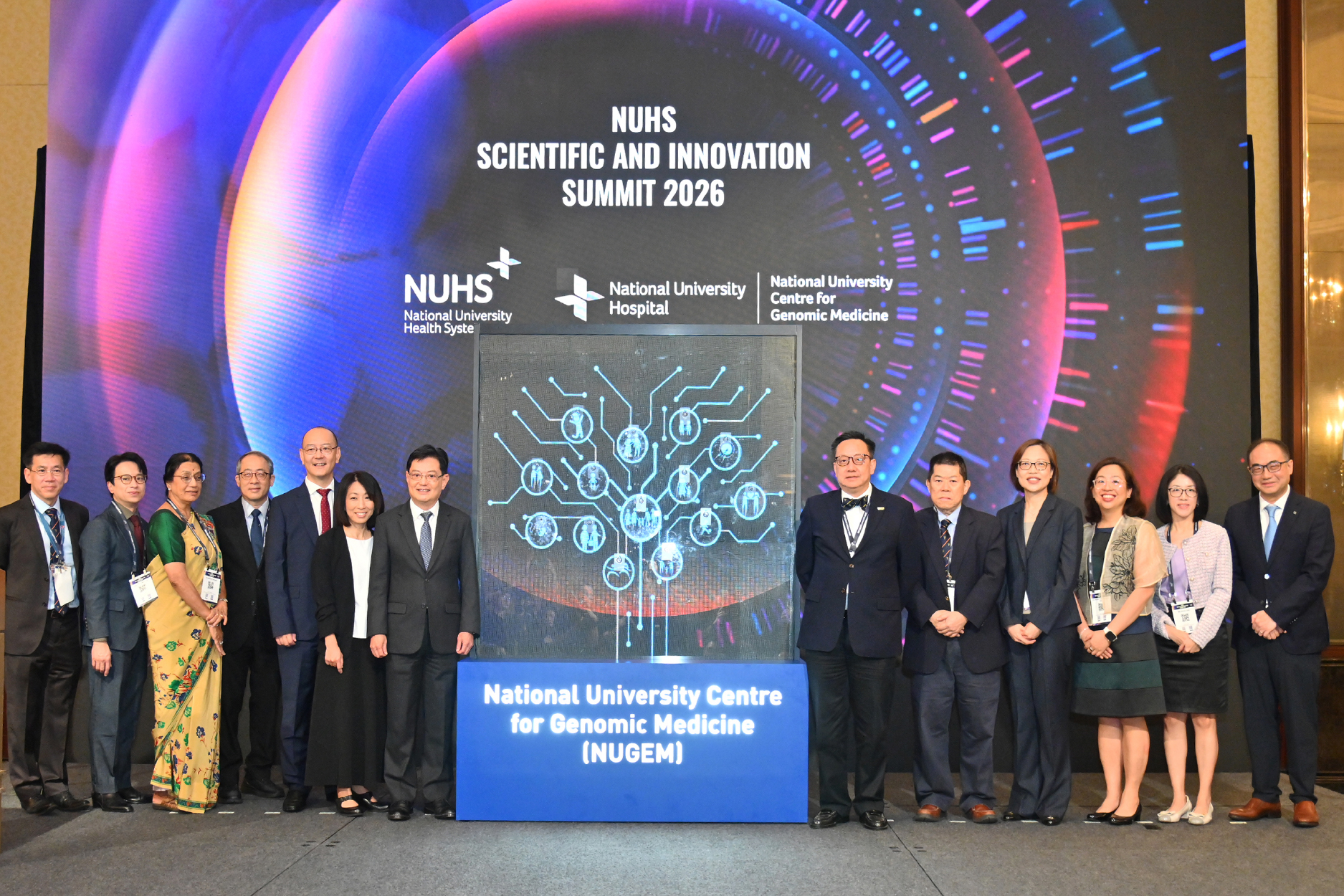
Officially launched on 2 April 2026 by the National University Hospital (NUH), the National University Centre for Genomic Medicine (NUGEM) serves as a bridge between genomic science and everyday clinical decision-making. It ensures the genetic insights reach healthcare providers, patients, and families at the moments when care decisions matter.
This vision was formally recognised at the National University Health System’s (NUHS) biennial Scientific and Innovation Summit, where Mr Heng Swee Keat, Chairman of the National Research Foundation, officially launched NUGEM. In his opening address, he emphasised the significance of this milestone: “The move towards genomic-informed, precision care, underpinned by data-driven population insights, is accelerating and marks an important step towards care that is tailored.”
Led by a multidisciplinary team of clinicians, scientists, and researchers from NUH, the National University Centre for Women and Children (NUWoC), the National University Polyclinics (NUP), the National University Cancer Institute, Singapore (NCIS), the National University Heart Centre, Singapore (NUHCS), and Yong Loo Lin School of Medicine, National University of Singapore (NUS Medicine), NUGEM builds the laboratory and digital infrastructure needed for genomics-ready healthcare, while developing programmes that equip healthcare professionals to confidently use genomics and precision medicine in their practice.
“NUGEM is about transformation. It transforms the way we think about genomics in clinical care across our entire workforce, leveraging the strong foundations we have in digital and research ecosystems,” says Associate Professor Ng Kar Hui, Director of NUGEM1. “The Centre will enable more precise and personalised treatment, leading to better outcomes, and most importantly, delivering clarity, confidence, and hope to patients and their loved ones.”
Understanding risk, guiding care
At NUH, genomic testing is already supporting care in settings ranging from prenatal clinics to intensive care units (ICUs). By identifying underlying genetic factors, clinicians can address the root of the conditions rather than managing symptoms alone.
For example, in critical care, genomic insights can alter the course of treatment within days. A previously healthy woman in her early 30s was admitted to the ICU with severe melioidosis, a bacterial infection that led to multi-organ failure. Despite intensive support, her condition did not improve. Urgent genetic testing revealed a rare immune deficiency — CASP4 deficiency — that explained her vulnerability to infection. With this insight, doctors adjusted her treatment. Within days, her condition stabilised, and she eventually recovered and returned to work.
Genomics also plays an important role in reproductive planning. Ms Ng Zhuang Shu was diagnosed with diabetes in infancy and has been receiving endocrinology care at NUH from paediatrics through to adult services. When she told her current endocrinologist about her desire to start a family and better understand her condition, she was referred to Adj A/Prof Chin Hui-Lin2, who became her clinical geneticist throughout her family planning journey. Genetic testing confirmed a pathogenic variant associated with insulin dependent neonatal diabetes, clarifying the risk of passing the condition to her children. With this knowledge, she and her husband underwent in vitro fertilisation with pre-implantation genetic testing for monogenic disorders (PGT-M) to select embryos free of the familial variant. During her second trimester, prenatal genetic testing further confirmed that her baby girl, born in 2025, did not carry the familial variant. Today, she is a proud mother of a healthy five-month-old.
While Ms Ng spent a high four-digit sum on the genetic testing, she believes it was worthwhile, noting that the cost savings would be far greater than what the family would have faced if her daughter had inherited the same condition.
Adj A/Prof Chin echoes Ms Ng’s sentiment, noting that studies have shown genetic testing can save costs in the long run. “Individual tests may seem costly at first, but if a person is dealing with a chronic illness, every investigation, scan, visit, and medication adds up,” she explains. “Genetic testing can help avoid unnecessary procedures and their associated costs. Additionally, as the technology advances, genetic testing is becoming more affordable and accessible, with government subsidies available to help offset expenses for certain tests.”
For others, genomic testing helps resolve uncertainty that has lasted for years. A young man with suspected Alport syndrome — a hereditary kidney condition — had inconclusive test results as a child. As his symptoms progressed into early adulthood, newer genetic testing methods are now being used to establish a definitive diagnosis without the need for invasive procedures such as a kidney biopsy. This will guide his treatment and clarify long-term risks, including what the diagnosis means for future generations of his family.
Safer medicines for more patients
Beyond diagnosis, genomics is also shaping how treatment decisions are made. Pharmacogenomics — the study of how genes affect an individual’s response to medications — helps doctors choose medications and dosages more likely to work, while reducing the risk of side effects.
“Local data from more than 2,000 patients found that over 20 per cent carry variants that affect how they respond to medications that have been prescribed to them,” says Dr Elaine Lo, Principal Clinical Pharmacist at NUH. “These insights help clinicians make more informed prescribing decisions. Doctors can tailor prescriptions to reduce the risk of adverse drug reactions while ensuring patients receive treatments that they are most likely to respond to.”
Efforts are underway to expand the use of pharmacogenomic testing so that genetic insights can be more consistently integrated into care across different medical specialties.
Bringing genomics to clinical care, one patient at a time
Within the next decade, it is estimated one-third of clinic consultations will involve genomics in some form. Supporting this is the NUH Genomics Diagnostic Laboratory, which analyses genomic data to identify variants that explain or better characterise disease, helping to guide more precise treatment. Situated within NUH, the laboratory enables genomic findings to be generated close to where care is delivered, allowing for timely results and more confident clinical decision-making.
“I can better connect with the care providers, to convey a deeper understanding of how the variant(s) lead to the disease, particularly in complex and ambiguous cases,” says Dr Desirée du Sart, Principal Scientific Officer, Department of Laboratory Medicine, NUH.
At the launch, Mr Heng also spoke about the broader national outlook for genomics in Singapore. “In Singapore, genomics has become a national priority with concerted efforts to embed its use into routine clinical practice,” he noted. “Over time, these capabilities will also support our broader move towards prevention and population health, including the objectives of Healthier SG.”
1 A/Prof Ng is also a Senior Consultant at the Division of Paediatric Nephrology, Dialysis and Renal Transplantation, Department of Paediatrics, Khoo Teck Puat - National University Children’s Medical Institute (KTP-NUCMI), NUH; the Division of Genetics and Metabolism, Department of Paediatrics, KTP-NUCMI, NUH; and the Paediatric Kidney Transplantation Programme, National University Centre for Organ Transplantation, NUH.
2 Adj A/Prof Chin Hui-Lin is a Senior Consultant at the Division of Genetics and Metabolism, Department of Paediatrics, Khoo Teck Puat - National University Children's Medical Institute, National University Hospital.
KTP-NUCMI is part of the National University Centre for Women and Children (NUWoC), a national university specialist centre that aims to empower women, children and their families to lead healthier lives.
Like this article? Simply subscribe to make sure you don't miss the next issue of EnvisioningHealth!