Hand Hygiene in Healthcare
Hand hygiene refers to the process of cleaning the hands through handwashing or the use of alcohol-based hand rub solutions. In a healthcare setting, it remains the single most effective measure for reducing the cross-transmission of microorganisms, which can lead to healthcare-associated infections (HAIs), prolonged hospital stays, increased cost of care, and mortality.
Despite this being well established and widely taught across all categories of healthcare staff, compliance rates have historically remained low. Multi-centre studies conducted between 1981 and 1999 found hand hygiene compliance in intensive care units (ICUs) to be consistently below 50%. In response, the WHO World Alliance for Patient Safety launched a global initiative in 2004 to address HAIs, with hand hygiene promotion at its core. This has since spurred the development and implementation of various measurement tools and improvement programmes across institutions and countries.
Measuring Hand Hygiene Compliance at NUH
Healthcare institutions employ a range of methods to measure hand hygiene compliance, including direct observation by trained auditors, self-reporting by healthcare workers (HCWs), patient observation, monitoring of hygiene product consumption, and automated monitoring systems.
At NUH, the audit process is comprehensive and rigorous, covering 43 locations across inpatient wards, the ambulatory surgical ward, and ICUs. Since 2006, the NUH Infection Prevention Team has worked closely with hospital management and clinical stakeholders to continually refine its hand hygiene programme. This includes training and competency assessment of healthcare staff at all levels of seniority on proper handwashing techniques and the appropriate timing of hand hygiene.
Compliance monitoring is conducted through covert observation, meaning healthcare workers are not aware they are being observed. This approach minimises the Hawthorne effect — the tendency for individuals to alter their behaviour when they know they are being watched — thereby producing more accurate and representative data. Compliance is calculated as the number of hand hygiene actions performed divided by the number of opportunities requiring hand hygiene, expressed as a percentage.
NUH follows the WHO's "Five Moments of Hand Hygiene" framework, which identifies the key points at which hand hygiene must be performed: before touching a patient, before a clean or aseptic procedure, after body fluid exposure risk, after touching a patient, and after touching patient surroundings.
Training and Awareness
Hand hygiene education begins during students' clinical attachments and is reinforced during orientation for all new staff. Posters on proper handwashing techniques are displayed at strategic locations throughout the hospital. Annual initiatives such as Hand Hygiene Week, interactive educational sessions, and webinars have helped to sustain staff awareness and engagement. Formal hand hygiene assessments are conducted every two years.
Compliance Outcomes
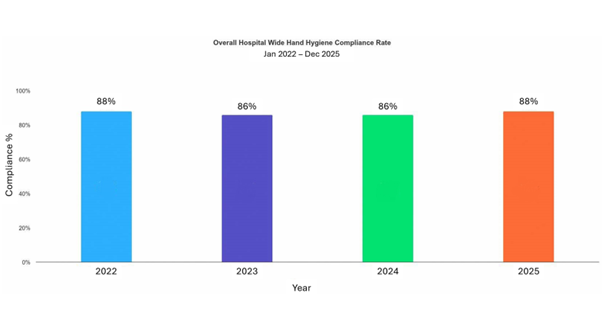
The chart below (Figure 1) presents NUH's annual hand hygiene compliance rates from 2022 onwards. Results have been encouraging, with the hospital targeting a compliance rate of above 75%. More than 10,000 observations are conducted hospital-wide each year by trained auditors, providing a robust and reliable dataset from which to track progress and identify areas for improvement.
Figure 1: Hand Hygiene Compliance in NUH (all 43 locations)