 Subscribe and ensure you don't miss the next issue!
Neovascular age-related macular degeneration (nAMD), also known as “wet” AMD, is one of the leading causes of blindness worldwide. It affects around 200 million people, including more than 125,000 Singaporeans aged 40 and above. By 2040, almost 200,000 Singaporeans are projected to be affected by nAMD. The disease damages the macula, the central part of the retina responsible for sharp vision, making once-simple activities such as reading, driving, and recognising faces increasingly difficult.
Today, the most common treatment for nAMD involves injecting medication directly into the eye as often as once a month. While effective, the discomfort, frequency, and inconvenience of these injections often discourage patients from keeping up with appointments, leading to undertreatment and the risk of vision loss. A new approach of delivering the medication is under evaluation and may soon change this.
Developed by Swiss healthcare company Roche, a rice-sized, refillable implant delivers a steady dose of medication over several months, reducing the need for frequent injections. The implant is currently being evaluated at the National University Hospital (NUH), one of the four sites in Singapore, which is the only country in Southeast Asia participating in the international trial.
The ongoing study, which runs until 2026, is evaluating whether the implant can be safely refilled every nine months instead of every six, building on data that has already led to approval by the US Food and Drug Administration (FDA).
A new way to manage vision loss
In nAMD, vision loss occurs when abnormal blood vessels grow beneath the macula. These vessels are fragile and prone to leaking fluid or blood, leading to swelling, scarring and rapid deterioration of central vision. If left untreated, the condition can progress quickly and irreversibly.
Current therapies work by blocking signals that drive the growth of these abnormal vessels. Injected into the eye, drugs such as the commonly used ranibizumab help to slow or halt disease progression. However, for many patients, this means returning to the clinic every month for repeated injections — a demanding regimen that can be difficult to sustain.
The new implant under study takes a different approach. Inserted through a short procedure, the device slowly releases ranibizumab over several months and can be refilled in a clinic twice a year. This reduces the need for repeated injections and offers more consistent delivery of treatment.
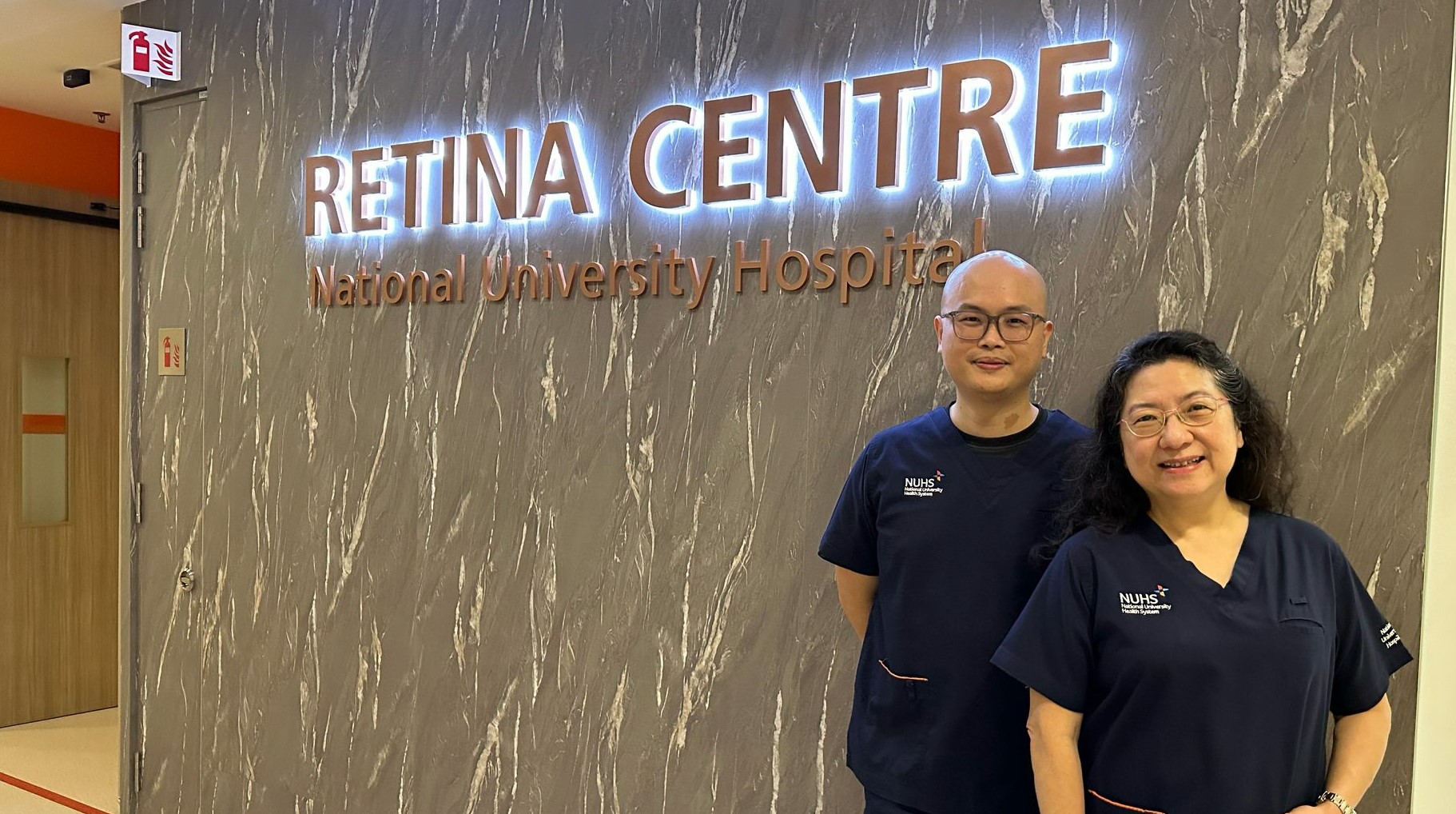
“Only newly diagnosed nAMD patients qualify for the study. At NUH, eight patients have received the implant so far,” says Dr Yuen Yew Sen, Senior Consultant, Department of Ophthalmology, NUH, who is involved in the study. “Once the treatment becomes available commercially, most patients with nAMD should be eligible, except for those with other eye conditions such as glaucoma.”
Also involved in the study, A/Prof Caroline Chee, Senior Consultant at the same department, adds that patients adapt well to the device. “Beyond some minor discomfort after surgery, patients often do not even notice the implant is there once healing is complete,” she explains.
One of the NUH trial participants, 79-year-old Madam Khoo Shock Nee, joined the study after being diagnosed with nAMD in her right eye. Since receiving the implant earlier this year, Madam Khoo no longer needs injections every one to two months and now only requires a refill once every nine months. She also no longer feels the discomfort once associated with repeated injections. Her daughter, who accompanies her for follow-ups, shared that the treatment has also eased the family’s caregiving load.
Looking beyond nAMD
The potential of refillable eye implants goes beyond nAMD. Similar systems are already used to treat glaucoma, and the FDA has recently approved the delivery platform for the treatment of diabetic retinopathy — another major cause of vision loss.
“If these implants can be adapted for other eye diseases, we may be able to reduce the need for repeated injections across multiple conditions,” adds Dr Yuen. “That could make long-term care more manageable for patients and clinicians alike.”
Like this article? Simply subscribe to make sure you don't miss the next issue of EnvisioningHealth!