 Subscribe and ensure you don't miss the next issue!
Very few people can imagine growing up knowing that surgery would be a recurring part of life — not to cure an illness outright, but to make everyday things possible: breathing comfortably, protecting one’s eyesight, speaking clearly, or simply looking in the mirror without fighting the urge to recoil in discomfort.
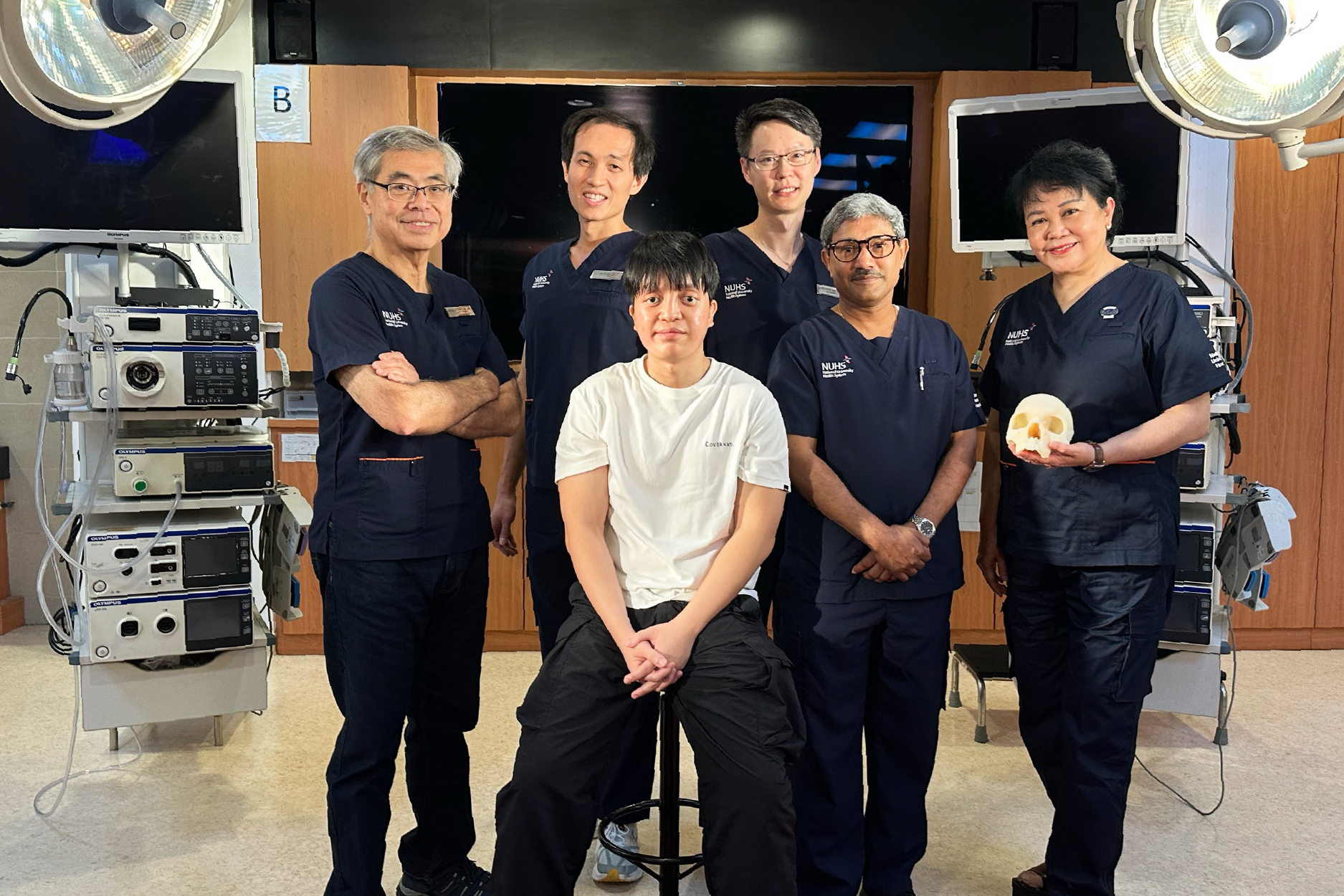
For Mr Tobie Goh, this has been a reality since he was a baby boy. Diagnosed at just 18 months with Crouzon syndrome, a rare genetic condition affecting skull and facial bone development, Tobie has undergone four major reconstructive surgeries under the care of a multidisciplinary team at National University Hospital (NUH). A fifth procedure is being planned.
Today, at 23, he is doing something that once seemed completely unattainable: training for his first half-marathon.
A condition that unfolds over time
The early signs were apparent at birth. Baby Tobie’s head shape was abnormal, his eyes protruded, and the middle of his face appeared sunken. Doctors later confirmed Crouzon syndrome, a condition in which the fibrous joints between skull bones fuse too early. This restricts space for the growing brain and alters facial development.
In the general population, skull sutures remain flexible through childhood and only fuse fully in adulthood. In children with Crouzon syndrome, one or more sutures may fuse during infancy. The consequences can be wide-ranging and include increased pressure on the brain, breathing difficulties, vision and hearing problems, dental misalignment, and sleep apnoea. The condition affects roughly one in 25,000 people worldwide and typically appears within the first year of life.
Early intervention was essential. At just over a year old, young Tobie underwent his first cranial surgery to relieve pressure on the brain and allow room for normal development, performed by Associate Professor Lim Thiam Chye, Senior Consultant, Division of Plastic, Reconstructive & Aesthetic Surgery, Department of Surgery, NUH. The operation reshaped his skull and moved the forehead and upper eye sockets forward — a careful balance between protecting neurological function and correcting facial structure.
“The first two years of life are critical because that is when the brain grows most rapidly,” explains Adjunct Associate Professor Vincent Nga, Head of Division & Senior Consultant, Division of Neurosurgery, Department of Surgery, NUH, who has followed Tobie’s neurodevelopment over the years. “Any delay can carry long-term consequences.”
It truly takes a village
What followed was a carefully sequenced journey that stretched across two decades. Tobie’s care involved plastic surgeons, neurosurgeons, an ophthalmologist, and a craniofacial orthodontist, each addressing different needs as his face and body matured.
As a child, Tobie struggled to breathe properly and required a bilevel positive airway pressure machine during sleep. His eyes could not close fully, leading to dryness and discomfort. An underbite made chewing and speech difficult. Strenuous physical activity was out of the question.
At age 20, he underwent a second cranial operation to further reposition his forehead, improving eye protection and allowing his eyelids to close fully. Adjunct Associate Professor Gangadhara Sundar, Senior Consultant, Department of Ophthalmology, NUH, was part of the surgical team, ensuring that the eyes and optic nerves were protected throughout.
“Conditions like Crouzon syndrome affect not just appearance but vision and eye function,” he explains. “Shallow eye sockets can leave the eyes exposed, while changes in facial structure may lead to misalignment, reduced vision, or long-term damage if not addressed early.”
He adds that surgical reconstruction requires careful coordination to safeguard delicate structures. “Procedures involving the mid-face can affect eye muscles and tear drainage pathways, so these need to be preserved at every stage to maintain vision and function,” he says. “These conditions are part of a broader group of complex cranio-orbitofacial disorders — from congenital anomalies to severe facial trauma and tumours — where multiple specialties work together over long, carefully planned operations to restore both function and form.”
A third major surgery in 2024 focused on advancing the mid-face and upper jaw — a complex, staged procedure designed to improve breathing, dental alignment, and facial balance. The planning involved close collaboration with Dr Catherine Lee, a Visiting Consultant at the Department of Surgery, NUH, who had been guiding Tobie’s jaw development since he was nine.
“We reduced the eventual surgical burden by combining strategic long-term orthodontic planning with carefully selected surgical and non-surgical approaches — helping avoid a more extensive two-jaw operation in adulthood while deliberately steering clear of lower jaw setback that could worsen his sleep apnoea,” Dr Lee explains.
Last November, a fourth procedure refined his bite and dental alignment. A final operation, expected to adjust the lower eye sockets and nasal structure, is being considered.
“Managing Tobie’s condition was a delicate art, requiring patience, finesse, and planning from a multidisciplinary team, as his facial structure continues to change and his functional needs evolve with each stage of life,” adds Dr Elijah Cai, Consultant, Division of Plastic, Reconstructive & Aesthetic Surgery, Department of Surgery, NUH, who was also directly involved in Tobie’s reconstructive surgery. “It was like a 3D jigsaw puzzle — every dimension was important, as any error in the movement would affect the other dimensions.”
Looking ahead
Today, Tobie is completing his accountancy degree, preparing to enter the workforce, and training for a half-marathon.
“I was never able to do strenuous exercise as a child because breathing was difficult,” he says. “Running is something I am finally able to work towards."
Like this article? Simply subscribe to make sure you don't miss the next issue of EnvisioningHealth!