 Subscribe and ensure you don't miss the next issue!
Until recently, patients at the National University Hospital (NUH) undergoing a positron emission tomography/computed tomography (PET/CT) scan — one of the key tools in cancer diagnosis — would spend up to 15 minutes lying still as the scanner captured their body in segments. Each pause and reposition added time, patient discomfort, and additional exposure to radiation.
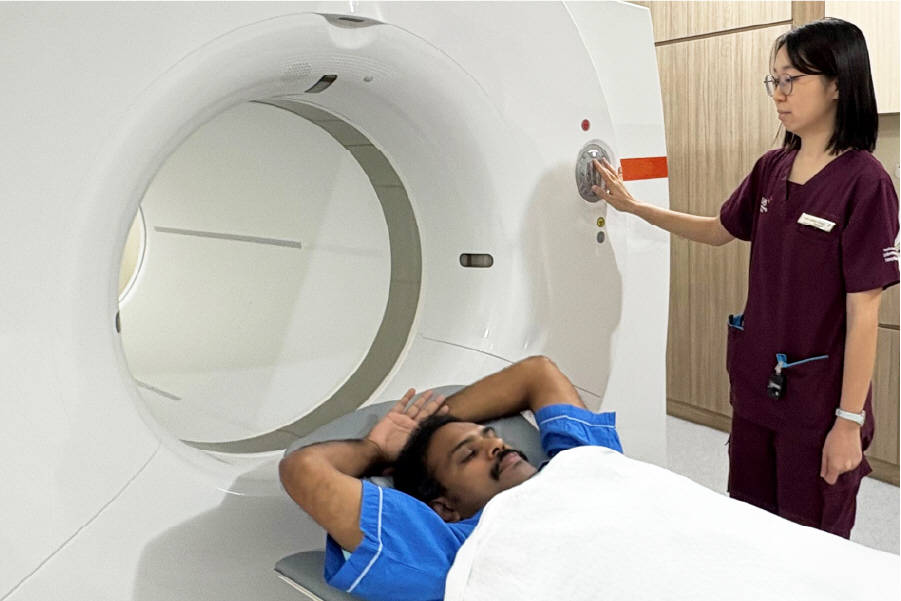
That experience has changed. Powered by a total-body PET/CT system, the hospital’s newly launched Molecular Imaging and Theranostic Centre now enables scans that are faster, clearer, and more comfortable for patients. The system also advances research that could transform how diseases such as cancer are detected and treated.
Established together with the Yong Loo Lin School of Medicine, National University of Singapore (NUS Medicine), the new integrated facility is located at the NUH Medical Centre. It represents a transformative leap forward in precision oncology imaging and radioligand therapy, where diagnosis is informed by a deeper, more comprehensive view of the human body, and treatment can be targeted based on the identification of specific molecular targets in the cancer.
Faster, safer and more accurate scans
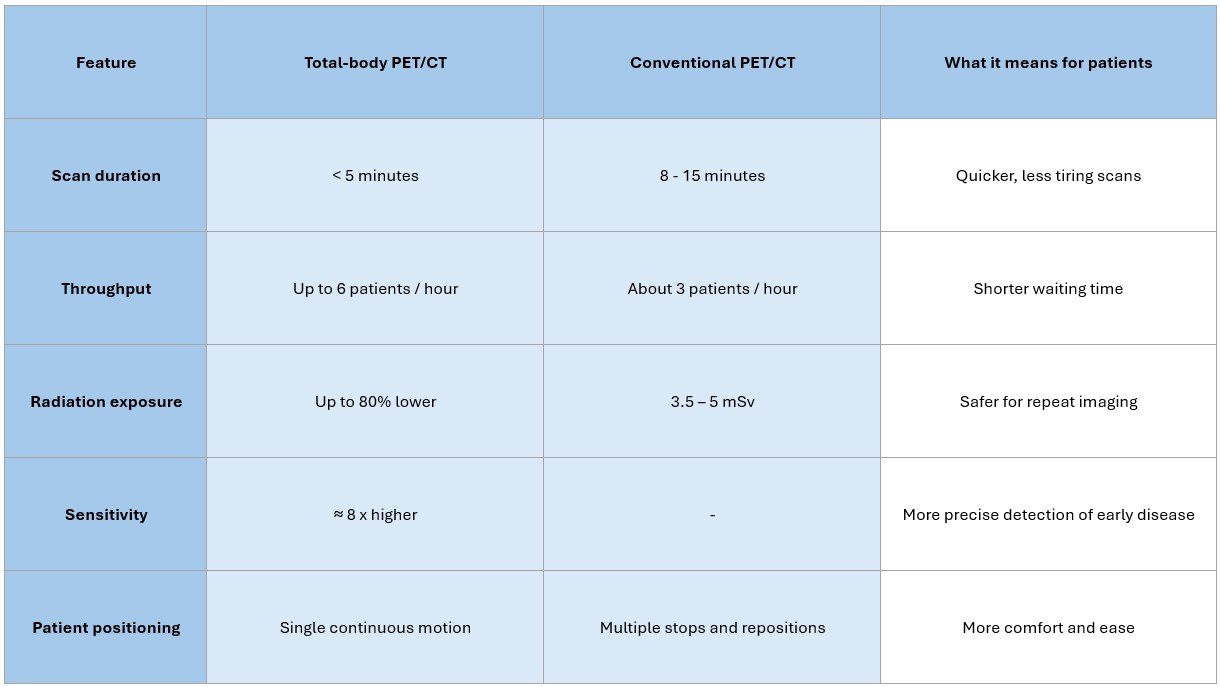
The new total-body PET/CT system captures the whole body in a single, continuous motion without any pauses nor repeated repositioning. The process takes less than five minutes and uses up to 80 per cent less radiation than before.
The improvement goes beyond just convenience. The scanner’s heightened sensitivity — about eight times that of conventional systems — produces sharper, more detailed images that can reveal minute lesions and early changes in disease activity. Such clarity helps clinicians plan treatments with greater confidence and monitor how patients respond over time.
“Total-body PET/CT allows us to capture the whole body in a single bed scan with unmatched clarity,” says Professor Khong Pek Lan, Head and Senior Consultant, Department of Diagnostic Imaging, NUH. “Patients benefit from faster, safer and more precise diagnoses, while our clinicians can harness these insights to explore innovative therapies more effectively. This is a step forward in personalised medicine.”
The system’s broader field of view of more than one metre — more than four times that of conventional scanners — allows the whole body to be imaged at the same time. This reduces scan time and hence increases scanning capacity — up to six patients an hour — reducing waiting times and improving overall workflow at the Centre.
Table 1: Differences between total-body and conventional PET/CT
From imaging to precision oncology
Modern cancer care is increasingly driven by precision — tailoring diagnosis and treatment to the biology of each patient’s disease.
Radioligand therapy is an emerging technique that uses the same molecular target to both detect and treat cancer with radioactive isotopes. First, doctors inject a small amount of radioactive tracer that highlights specific molecular cancer targets on scans. If detected, the cancerous cells can then be treated by delivering targeted radiation that destroys them while sparing healthy tissue.
With the total-body PET/CT system, researchers can now observe how these tracers travel through the body in real time, revealing how drugs are distributed and how patients respond to therapy over time. These insights are invaluable for designing more effective treatments and refining existing ones.
To strengthen collaboration in this growing field, NUH, NUS Medicine and Siemens Healthineers have signed a Memorandum of Understanding to advance clinical diagnostics, translational research, and technological innovation. The partnership strives to enhance Singapore’s capabilities in molecular imaging and theranostics, positioning the city-state as a regional hub in precision medicine.
“Our research focuses on developing more specific and effective radioactive tracers for cancer diagnosis and treatment,” says Prof Khong, sharing a glimpse into the work now taking place at the Centre. The new Centre allows us to bridge discovery and clinical care more seamlessly than ever before.”
Like this article? Simply subscribe to make sure you don't miss the next issue of EnvisioningHealth!