Health Resources

Haemophilia (Children)

2026/02/20
What Is Haemophilia

Haemophilia is a genetic bleeding disorder where blood lacks a crucial clotting factor, leading to prolonged bleeding. There are two main types: Haemophilia A, caused by a deficiency in Factor VIII and Haemophilia B, caused by a deficiency in Factor IX. This condition, which mainly affects males and is rare in females, means children with haemophilia bleed more easily than others and may experience prolonged bleeding from even minor injuries. 

Internal bleeding, such as in the joints, brain or abdomen, poses a significant risk and can result from minimal trauma or even spontaneously, without any apparent cause. External bleeding from minor cuts may be prolonged but are easier to manage through immediate recognition and direct pressure, and less of a concern than the potentially life-threatening internal bleeding. 

Causes Of Haemophilia

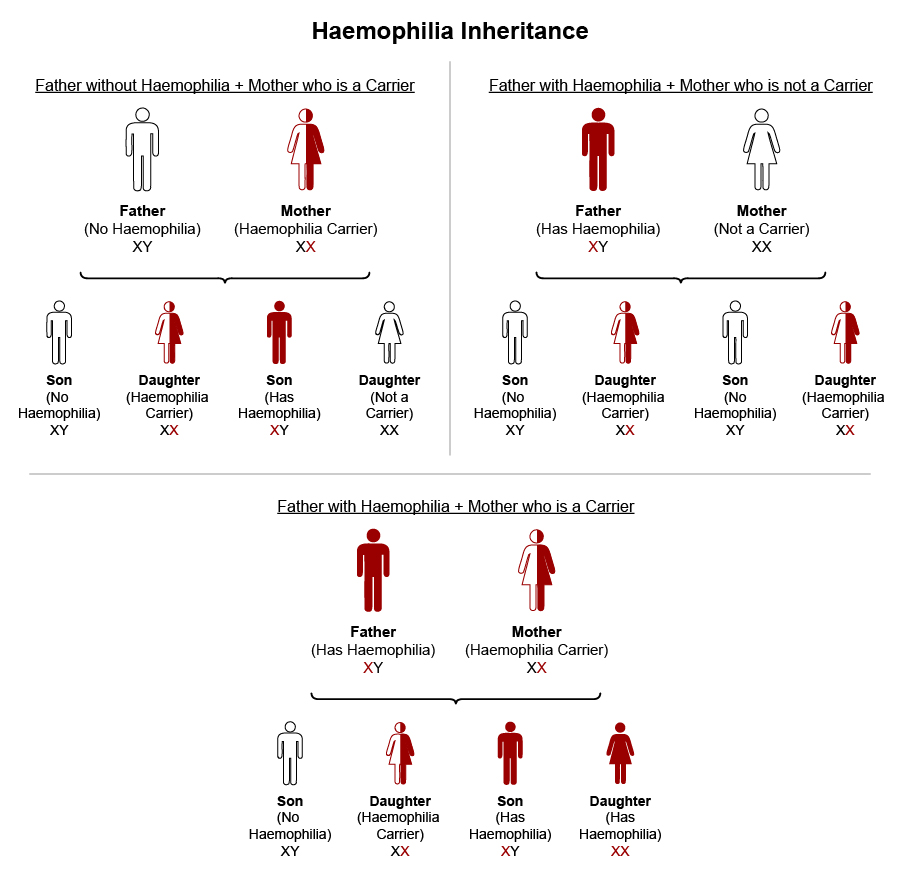
Haemophilia is an X-linked condition, with the gene mutation located on the X chromosome. Since males have one X and one Y chromosome (XY), whereas females have two X chromosomes (XX), the inheritance patterns differ between the genders. A male with the haemophilia gene mutation on his X chromosome will have the condition, while a female carrier with the mutation on one X chromosome usually does not exhibit symptoms due to the presence of a normal second X chromosome. 

The possibilities of inheriting this condition are as follows:

  • A carrier mother has a 50% chance of passing the gene to her children, meaning her sons have a 50% chance of having haemophilia and her daughters have a 50% chance of being carriers. 
  • A father with haemophilia will pass his normal Y chromosome to his sons (making them unaffected) and his affected X chromosome to his daughters (making them carriers). 
  • In the rare instance that both parents carry the haemophilia gene, there is a 50% chance their daughter will have haemophilia. 

Haemophilia Inheritance Chart

Approximately 30% of haemophilia cases arise from a spontaneous mutation, with no family history of the condition1.

Source

1. National Hemophilia Foundation

Signs And Symptoms Of Haemophilia

Signs of haemophilia include easy bruising and spontaneous joint or muscle bleeds without significant injury. The most severe bleeding occurs in the brain and abdomen, which can be life-threatening and lead to permanent disabilities. 

Haemophilia is a genetic disorder that can be present from birth. However, signs of bleeding typically become evident after an injury. In newborns, bleeding complications may arise during or shortly after birth, particularly following a prolonged or complicated delivery. Children with severe haemophilia often display excessive bruising when they begin to crawl and experience joint bleeds as they start walking. Milder forms of haemophilia may not become apparent until later in childhood or adolescence. 

Diagnosis And Treatment Options For Haemophilia

Gene therapy is currently the only cure for haemophilia2 but it is very costly. Haemophilia can be managed effectively with factor replacement therapy. This treatment involves injecting the missing clotting factor—Factor VIII for Haemophilia A or Factor IX for Haemophilia B—directly into the bloodstream. Treatment approaches include: 

Prophylactic (Preventive) Therapy: 

Regular injections of the clotting factor are administered to prevent bleeds, especially in children with severe haemophilia, who are at risk of spontaneous bleeding. 

On-demand Therapy: 

Injections are given in response to bleeding episodes such as joint bleeds that present with joint swelling, warmth or pain. 

The dosage of Factor VIII or IX concentrate is determined by the child's weight and the severity of the bleed, and must be prescribed by a doctor/haematology specialist. Parents usually keep a supply at home for immediate use, with instructions on proper storage and administration provided for home therapy. 

Children with hard-to-access veins may require a Portacath—a device implanted under the skin that allows easy access to a central vein for medication administration. The Portacath may need to be replaced if it becomes blocked or infected, and it typically lasts 2 to 3 years. 

In cases of severe internal bleeding, such as brain or abdominal bleeding, emergency hospital treatment with high-dose factor replacement therapy is essential. 

Inhibitors 

Some children develop inhibitors—antibodies that neutralise the clotting factor, rendering replacement therapy ineffective. This occurs in approximately 20–30% of individuals with Haemophilia A3 and 1.5-3% with Haemophilia B4 undergoing factor replacement therapy. The risk of inhibitor development is linked to the type of genetic mutation present. 

Managing haemophilia with inhibitors is challenging. For individuals with low inhibitors levels, higher doses of factor concentrate may be effective in controlling bleeding. However, patients with high levels of inhibitors require bypassing agents like recombinant activated Factor VII (Novoseven) or Factor Eight Inhibitor Bypassing Activity (FEIBA) for treatment of bleeds. Immune Tolerance Induction (ITI) therapy, involving daily or regular high-dose factor concentrate administration until inhibitors are eradicated, can also be used. ITI is successful in about 70% of patients with Haemophilia A5 ,typically taking 6 to 12 months to achieve success.  

Emicizumab (Hemlibra), a bispecific monoclonal antibody given as a subcutaneous injection (injection into the fatty layer under the skin) is also used to prevent bleeds in haemophilia with inhibitors6

Source:  
2. Glasner MF, Pipe S, Miesbach W. Gene-based therapies for hemophilia. Res Pract Thromb Haemost. 2025;9(4):102870. Published 2025 Apr 25. doi:10.1016/j.rpth.2025.102870 

3. Leissinger CA. Prevention of bleeds in hemophilia patients with inhibitors: emerging data and clinical direction. Am J Hematol. 2004;77(2):187-193. doi:10.1002/ajh.20162 

4. DiMichele D. Inhibitor development in haemophilia B: an orphan disease in need of attention. Br J Haematol. 2007;138(3):305-315. 

5. Antun A, Monahan PE, Manco-Johnson MJ, et al. Inhibitor recurrence after immune tolerance induction: a multicenter retrospective cohort study. J Thromb Haemost. 2015;13(11):1980-1988. doi:10.1111/jth.13143 

6. Oldenburg J, Mahlangu JN, Kim B, et al. Emicizumab Prophylaxis in Hemophilia A with Inhibitors. N Engl J Med. 2017;377(9):809-818. doi:10.1056/NEJMoa1703068 

Tips For Taking Care Of Children With Haemophilia

Children with haemophilia should avoid contact sports and activities posing a risk of abdominal or head injury due to the severe consequences of internal bleeding. Nonetheless, they are encouraged to engage in suitable physical activities, such as swimming and non-contact sports, to strengthen joints and muscles, thereby reducing the likelihood of bleeds. Those on prophylactic replacement therapy may safely participate in more vigorous exercise and enjoy a normal lifestyle. 

Families are educated about early bleeding signs so they can promptly administer factor concentrate injections at home. It is important to avoid medications that worsen bleeding, such as aspirin and warfarin. 

Useful Links

Research On Haemophilia

Continued clinical research is essential for advancing paediatric healthcare. Our doctors are committed to contributing to the future of child health and medicine through both clinical practice and research. 

  • Ng HJ, Lam J, Koh PL, et al. A comprehensive study of current haemophilia care and outcomes in Singapore. Haemophilia : the official journal of the World Federation of Hemophilia, 2015(5):e428-31. doi: 10.1111/hae.12729 
About Us
The Department of Paediatrics, Khoo Teck Puat – National University Children’s Medical Institute (KTP-NUCMI) is part of the National University Centre for Women and Children (NUWoC)

Our paediatricians provide comprehensive and specialised medical and surgical services for newborns, children and adolescents. 

Click here for information on how to make an appointment with our paediatricians. 
Health Resources
Click here to view more resources on women and children’s health.  
Last updated on
Best viewed with Chrome 79.0, Edge 112.0, Firefox 61.0, Safari 11
National University Health System
  • National University Hospital
  • Ng Teng Fong General Hospital
  • Alexandra Hospital
  • Tengah General and Community Hospital
  • Jurong Community Hospital
  • National University Polyclinics
  • Jurong Medical Centre
  • National University Cancer Institute, Singapore
  • National University Heart Centre, Singapore
  • National University Centre for Oral Health, Singapore
  • NUHS Diagnostics
  • NUHS Pharmacy
  • NUHS Regional Health System Office
  • NUS Yong Loo Lin School of Medicine
  • NUS Faculty of Dentistry
  • NUS Saw Swee Hock School of Public Health
Back to Top